October 4, 2013

The French School System (Part 3)

Welcome to Lycee - High school

This is where the system really gets interesting. And I don't just mean course wise - it's almost a complete opposite of the American system. Other than the "School" aspect of it, they have nothing in common.
Maybe I'm being a little harsh. I mean, it's a place of learning, right? But it's also the place you learn the hardest life lessons: like how to cope with failure.
Because, truth is, you fail, and you fail a lot. It's just life. There's no arguing, no cookies, no pats on the back - you have to push yourself all the way through it. Lycée is the gauntlet of life.

My dad used to say I had the "worst of two worlds".  I had the hormonal mess of living and working with teenagers, which meant drama. But I was in an environment much like that of university, with strange hours, all nighters, and four hour long tests.

2nd, however, is your last year of "freedom". You have about 30 hours of class a week (more if you're doing an OIB - details on that later), which are spread out over five days from 8 am to 6 pm. Unlike middle school, you can now leave the school premises whenever you want. The gates are always open, and you can come and go as you please. You can eat at the cafeteria or at the local eateries. In that respect, you're basically in a university environment, just with teenagers.
I say "freedom" here because, although you are tested every week by your teachers, you don't have exams. You work, and you live. You still have a social life.

Then comes 1re. And its all downhill from here.
I recommend you read this wikipedia page. I'll try to explain the process as best I can, but this website will give you more details.

At the end of 2nd, you pick the diploma you're going to work for. It's like choosing a major. You can do an S baccaleureate - this is science strong; An ES Bac (Economics based); or L (Literature). You can also go for a "professional" degree, a BTS, but that takes longer. This will determine the classes you will take. Unlike in the states, you can't pick and chose your classes, only menus. You can, however, pile on extra hours, if you want to study Latin, for example, or History of the arts. You can also sign up for the French CNED (distance classes) and take classes your school does not offer: a few of my friends took Chinese this way.
I was also in the OIB section, which meant I would take my English Bac in English, as well as history geography. It meant 10 extra hours on my schedule. I have to say, these were the highlight of my day. The teachers were incredible.
For the French, it's always "Passe ton Bac D'abbord", have you bac first. This is the priority from now on. Which means no free time, nothing but constant study.

Maybe I should remind you that there are no clubs. The few that are organized have been created by students, and only meet once a week. Our school had 5 to 6 on thursday allocated to them, but many other schools don't have any at all. So no yearbook, unless you make it yourself. No school dances, unless your organize it yourself.
You have two hours of sport per week, but there are no competitions between schools. If you want to go to a school for professional sports, you can do that; but you're not going to see any people getting into higher education for cheerleading here.
If you want to do music, you most likely go to the local conservatory, but it's rare that schools have music programs.

In 1ere, part of the curriculum is "TPE", or research. You create a team of 2 to 4 people, and then write a research paper together for the next six months. You're expected to write anywhere between 20 to 40 pages. Then you have to do a presentation before a panel of two to three examiners, who will give you a grade out of 20. This counts for the Bac.

A quick grade reminder: in high school, 10 is pass, 12 is pretty good, 14 is good, 16 very good. If you have a 13 - 14 average, you are an A student. But you will never, ever get a 20.  This video from numberphile will clear things up for you.

You finish 1ere by taking your first Bac exams. Every student takes the French exam, a 4 hour written exam in which you pick to do "creative writing" (usually seen as the refuse of the accademically poor, and not graded very well), a commentary* on an unseen text, or a dissertation. You usually hand in around 6 or more papers.  I wrote 12.
Then you have the French oral exam. During the year, you study 25 book extracts, poems, and selection of theatre. Your exam starts by you being handed a question on one of them. You half half an hour to prepare a response. Then you do an oral commentary of the text for ten minutes, and then have a dialogue for another ten about the world of French literature. You come out of it physically exhausted. And terrified.
L and ES students then have their Science bac to get it out of the way for next year. If you're in L, you're not obliged to take any math classes either. It's often joked about that the S students have the heaviest workload, because nothing is sliced off, but the Ls remind us constantly that their homework is writing dissertations, so we shut up.

By the time you reach Terminale, you're on the home stretch. You finally get to study philosophy, which is absolutely fascinating. You also get extra classes in your "specialty". Being in S, I got two extra hours of physics per week. 
All my free time, I spent in the library, with pretty much the rest of the student body. Homework was incessant. What was great, though, was how much the school bonded over this shared stress. There wasn't as much drama as you find in US schools, because we spent so much time worrying about work, we didn't really worry about anything else.
You don't have as much of a popularity contests in Lycee. There's no football team or cheerleaders, so there's half the problem resolved.

You can start applying to schools in this time, if you want to go to a private university, or if you want to take Prepa classes outside of university in the next year. These are small "boot camp" schools that help you prepare for the Concours (more on that later). The real application to universities starts in april, and all you have to do is put the order of university preference into your "Post Bac" account. The school uploads your grades and all those teacher comments from class councils. Then you wait until June to see where you are: you see the school you are accepted into (number however many on the list) and that's it: you'll go that if you get 10 or more on your Bac. Bam, done.
Other schools, like Sciences Po, are part of a different system. They require "concours", where you sit a written exam in an airplane hangar with thousands of other students, and an interview.

You sign up for the Bac by logging online to the site and filling out the subjects you're taking. Unlike the SAT, there are no personal questions, except what line of work your father is in (for for the yearly statistics on how personal income affects your score) and nothing else. They don't care about your ethnicity, your religion, your sexual orientation (I still can't believe I was asked that so I could take a standardized test!). And there's no 50 dollar fee - it's 4,96 euros for the administrator who has to process all of it. That's it.

Officially, it's the third week of June that you have your Bac, but all "options" have to be taken care of before then. So as May ends, you find yourself sitting for your extra exams (remind me why I took those?). Usually, you go to another school so that you have different teachers examining you, so there's no conflict of interest.

Then, one week before your first Bac, your classes are cancelled so that you can study. For an entire week, your entire focus is on those ten subjects you've been studying for the past two years. There's no way of knowing what will be on the test, you have to know everything. 
Then starts the test. You sit. You write. Hours and hours and hours. Page upon page upon page. Every math equation explained. Every philosophical quote referenced. Every scientific schema annotated. The worst part is knowing you can put your heart out on that sheet, and you can still have a 4 just because of subjective teachers. So you do your best and wait for the best.

In the first week of july, your grades are out. You go to your school, and wait until the grades are posted - they don't know when, so they don't say. Finally, they're pinned on the wall - if your name is on the list, you've got your Bac. If not, you've failed and have to take it again. You also may have a few letters next you your name: AB, B, or T, which indicate your "mention", the equivalent of an "honors". 
Then you wait in line to get your school file back. You sign a sheet, and your grades and record are handed to you. 
And just like that, you've graduated. Congratulations.

The next year is worse than your bac - I'm lucky to be out of it! - because everything is a competition. For most subjects (mostly med or engineering) you have one year of university before taking a massive test, the "concours", on which only your rank among other students matters. This tells you what you course of study you can do: if you top the list, you can be a surgeon, for example. This is why everyone takes prepa classes - it gives you a fighting chance on the concours. 
Maybe I should remind you at this point that the entire cost of one year in med school, with uni, prepa, and books, adds up to less than 200 euros?

So that's how the french school system works. I hope you've learned something! 

*Commentaries are no your usual essay. It's incredibly structured. Your introduction is followed by three "axes" (main ideas), each with three "sub axes", each of which is structured in their own specific way. You have to skip a certain number of lines and use a certain number of quotes - from memory, mostly - as well. Your conclusion ends with an "opening" which shows that you know other works of literature that resemble the unseen text you were given. A dissertation follows the same pattern, but corresponds to a question rather than analyzing a text.

October 2, 2013

The French school system (Part 2)

Le College (Middle School)

I think middle school anywhere can be boiled down to one essential problem: raging hormones and confusing pubescent teenagers crammed together and trying to learn how to deal with themselves and each other. Psychological torment, right there.

I went to college Mignet, smack in the middle of town, a great school that was formerly a nunnery and then a jail. Cezanne and Zola both went there (and were bros, so they say) and Pagnol was a teaching assistant there. It was incredibly old and not frequently repaired.

The year I got there, the mayor had decided that out gymnasium had to go, so that the city could have more parking spaces. I arrive at school the first day and there's a gaping hole with tall wooden fences surrounding it, and that was that. over the course of the next four years, this would constitute more and more problems. In 5eme, you couldn't hear any of the teachers in biology class because of all the construction noise right outside the window; I remember a class where we all wore ear plugs and the teacher just wrote on the board and waved at things with her hands. In 4eme, the diggers hit the foundations of the science building and that crashed down. In 3eme, they discovered that the automatic hookup for the drinking fountains in the temporary bathrooms had been tainted, and we had all been drinking basically poison for the past 4 years. Thankfully, no one was hurt through all of this.

But I digress: let's talk about how it works in France in general.

Schedules are arranged almost like in university. Hours are haphazardly piled on, so that sometimes you have an hour of nothing - which was called an hour of perm, an hour where you sit in a room and try to get homework done (most of the time, though, you don't have the right books because they're all at home) while somebody shouts at you the second you say a word. It's basically as if you're serving detention while having done nothing wrong: as a matter of fact, that's where students go to have detention. And you had perm two or three times a week, so that says a lot.
If you're lucky, you can get a slot in the CDI (the library), but our school had a very stingy librarian who barely ever let anyone in.
The hours usually go from 8 to 5 every day, with a half day on wednesday, but that would end at 2 instead of 12. This was prone to change if a teacher was absent or if you simply perm at the end of day, which meant you could leave early.

There are no lockers, yet you somehow have to have your books. Most schools aim to have in class copies of the books you have at home, to avoid you having to carry them every day, but most of the time they don't have money, so in you come every day with a 20 pound backpack on your back.

Every year, you are given something called a "carnet". It looks a little like an oversized passport. This is your whole year of school life. You carry your grades, your schedule, your "authorization to leave" card (if your day ends at three instead of five, you can leave school grounds this way), your absence tickets (fill them out and sign them once you've missed a day) and your tardy slips. Teachers could write notes to your parents, parents could write notes to teachers, you could schedule meetings, get detention...
In their eyes, the principal had more important things to deal with than students, so only if you were a real mess you would get sent to see him. Instead, there are people called CPEs, or student counselors (nothing to do with guidance counselors), one assigned to each year, which deal with disciplinary action and other student problems.
If you were a bad kid, teachers could write an "observation" in your carnet (forgot his stuff, was rude in class, didn't do homework), give you detention, or send you to the CPE for more drastic measures (exclusion from the school). Everything was recorded in that little paper book.

Now let's talk grades.
Everything is on a 20 scale. Again, no multiple choice questions, only long winded answers. Usually every question deserves at least a paragraph... even in math.
The scale is a little different between high school and middle school. In middle school, a 12 is a C, 14 a B, and 16 an A: high school it's more like 14 being an A, 12 a B, and 10 a C. In both cases, you never get a 20/20, even if you've got an excellent test. Why? Because there is no such thing as perfection. Life isn't fair. In the states, grades are used to boost confidence: in France, they must be pushed down, to force you to push yourself forward. That's why 16 is a very good grade: because you're always given less than you deserve, like in real life. Actually, it's not really about deserving, because it teaches you that in the real world, you don't really deserve anything. If you keep on expecting rewards for good deeds or good work, you'll never get anywhere. It's a painful life lesson.

You have a lot of classes. French, Physics/chemistry, SVT (biology and earth sciences), maths, sports, History, geography, English, "Second living language", "dead language" (optional), technology (computer science with a bit of business and marketing), Music, Art... But there are no clubs, except in a few random schools, and the sports clubs hardly ever meet, and never have any games. Not that anybody would really care.

You are placed into a class of about 30 people, who will share the same schedule and teachers as you (except in languages). That class is assigned to a teacher, your principal teacher as zhe is called, who is in charge of all your paperwork as well as their subject. Sometimes you will have homeroom instead of that subject so you can fill out papers and so on.
part of this is electing your class delegates. Each class elects two people who serve as the connection between them and the teachers. At the end of each 3 month term, the teachers will sit down with the delegates and the principal and do you "class council" (one per each class) to discuss if your grades are fair. You can tell your delegates, for example, that an issue at home has been messing with your ability to study, and n some cases your grades will be boosted. Each teacher will give you an appreciation ("good job", or maybe "tends to loose focus", just an observation on the term) which will go on your file. Then you're given your average for the term.
Again, it's very competitive. You want to be the best. Always competing with the people around you. Some schools are a little different in this regard, but ours had a lot of TCKs, and were's prone to fighting over academic excellence. No idea why.

Teachers are never substituted unless they are gone for a period over 2 weeks, so every morning we would rush to the absence board and see if we had some extra hours of freedom. Sometimes, they were the last teachers of the day so we could get out early - sometimes, they weren't, but through our delegates we could convince other teachers to teach us at different times so that we could have the afternoon off. It took a lot of finagling, but it always worked out in the end.

Primary schools are managed by the town, middle schools by the department and high schools by the region. So Money was spent in a confusing way.  Every year, we were given educational gifts: in 6th grade, a dictionary, in 7th, an atlas, in 8th, an HP computer. A very good one, too. But this made no sense, because in the school itself, It was always about managing without. For example, we never had enough sports equipment. Some of the colored shirts we had for team sports were so beat up we wore them tied around our waists like belts. Our changing rooms were rooms with no lockers, so often you would get your valuables stolen. I mean, you piled your clothes in a corner on top your school bag and hoped no one would touch them. That was it.
You always supplied your own materials for everything (though no biology class, except for that one time we were asked to bring in a bag of frog legs from our local grocery store), like in art, sports, music... My parents never believed me when I told them some of the things I needed for school, thinking I was just trying to get my hands on things they would never buy me otherwise.

As I said before, parents could never question the curriculum. I was reading dangerous liaisons in 8th grade as part of french class - nothing could be said against it.
And that was that.

At the end of 9th grade, you took the brevet, a test consisting of Math, French, History/geography, and in my case, English. It was a practically useless test which only served to give you a diplomas if you did not wish to continue your upper education. Because at this point, the choice was yours: if you were 16, you could leave school. You could go on to a "general" high school (like mine), a "professional" high school (technical, for learning a trade), or you could do a CAP, an apprenticeship (hairdresser, pastry chef) with a specific school part time.

So tomorrow, I will be talking about high school. Get ready for confusion, because it gets weird from here.

October 1, 2013

How the French school system works (Part 1)

Having undergone my entire schooling in france, I do have to say I've got a whole lot of knowledge on the subject. And, I have to say, it is a tough system, not just for TCKs (third country kids) like me, or many of my friends, but for French students as well. I thought maybe some of you would like some insight into the situation, so I've decided to do a series of posts on the subject... just for further information.
Maybe some of you are thinking of moving to france and putting your kids through the public school system here? Hopefully, these posts will help you know what you're getting into.

Let's start at the very beginning (a very good place to start)

How do the French view their education?
Two men stand at the base of the system: Napoleon Bonaparte, and Jules Ferry. Napoleon instituted many of the "obligatory courses" you see today, as well as starting the Baccalaureate system (1808), the end of high school diploma one must have to pursue a university degree. Unlike the American high school diploma, the Baccalaureate does not depend on the grades during the year, but on a 30 hour long written and oral exam at the end of the last school year. More on this later.
Jules Ferry is known of the man who made the French public school system "Free, obligatory, and Laique". Laique is the separation of religion from schools: no kid will wear any kind of religious sysbol (cross, head scarf) onto school grounds, and no teacher will teach religious beliefs.

The french pride themselves on how their schools create a meritocracy - since no one pays for their education, anyone can be what they want to be (so they say). Many French presidents have even come from farming backgrounds.

The thing about French schools is that it's all about the child's success. Grades are everything. There's no arguing with the teacher, or what they're teaching. The child goes to school, learns, and the parents are kept at arm's length. You have one or maybe two parent teacher meetings a year, and then, that's it. I remember filling out my own paperwork when I was in 3rd grade, asking only for my parents to sign. That's just normal.

The French also place an extreme importance on method: there are no multiple choice questions until university (or language courses in high school). You are graded on how resolve problems, not the answer you find. My parents could not help me with homework when I was a kid because their methods of revolving equations was different from the way I was taught in class, and I was penalized for it.

Kindergarten lasts for three years: PS (little section), MS (middle section) and GS (big section) are the class names.
Elementary/primary school lasts 5 years: CP (primary class, 1st grade), CE1 (elementary class 1) CE2, CM1 (middle class 1) and CM2.
Middle school lasts 4 years: From this point on, the grade numbers count down. 6eme (sixth grade), 5eme, 4eme, and 3eme. You then take the Brevet, a 15 hour exam, your first diploma (though you don't get any physical diplomas).
Finally, High school: 2nd, 1ere, and Terminale. Those last two years are Bac years and intense!
I will give you a lot more detail on that later.

Evert 6 weeks of class translated to 2 weeks of vacation. We sure need it, after all those hours of classes!

So let's walk though what it's like to go to elementary school, shall we?

L'ecole Primaire

For me, primary school was a joyful experience. I went to a tiny school in the St Marc commune, which had so little students that two classes were always taught together, and even then, we were no more than 20 or so students. The school's much larger now, but that was then.

But what I learned there was that competition was key. We were graded on a 10 (or sometimes 20) scale, 10/10 being perfect, 8/10 being average, 6/10 being poor or even a fail. And that little number was everything. To all of us.
You were never a Nerd for knowing too much: you were admired. You were pitied if you failed. If you had half a point higher than your best friend, you wouldn't talk for days. It was competition.
Of course, my parents not knowing the system, I never got the stress my friends were put under. Their parents would ground then for an 8. My dad would just look confused and ask me what it meant.

But other than that, we had a normal education. We were normal kids. We played games, loved marbles, scoobidoos (lanyards), and pokemon cards. Guys played soccer during recess. Once, a friend found and killed a worm - our whole year gave it a funeral. It was all very normal.

We started class at 9 and ended at 4:30, except on wednesday, which ended at 12, so that kids could do their extra curricular activities.

Lunch was out of this world. The cooks made full french meals, perfectly balanced, with an appetizer (salad of some sort) main course (veg, rice or coucous or pasta, and a meat, fish on friday - so much for being laique) dairy product (yoghurt or cheese) and a desert (pastry, cake, fruit...). We drank water (unlike milk in the states) and sometimes the town hall would have left over coke after a party, so if we were good and finished our plates, we could have  about a shot glass worth of coke. It was bliss.

Kids start learning English in 1st or 2nd grade, in the hopes that they'll be bilingual by high school graduation. The real emphasis was put on maths and french, with a poem being memorized every month or every two weeks.

The system is not perfect: the problem is subjectivity. I can remember in 2nd or 3rd grade, France was very opposed to a new war in Iraq, and, being the only american in the school, I got a full bulk of hate. It all started when the teacher told us to watch a news special on TV on the war. I didn't have french TV, so she said listen to the radio (didn't have that either), so I asked my parents what it was about, and they let me read news articles on google (THEY LET ME USE THE COMPUTER, AWESOME!). The next day we were told to write an essay. I got a meager 4/20 - I had never had anything less than a 16, so I was shocked. She then lectured me in front of the class about how the Americans - and I - were so, so wrong. I went home in tears.
But that's just how it is.
That same year, the teacher printed "official French ministry" papers (for april fools) announcing that we wouldn't have spring break because of "AMERICAN WAR". The 5th graders marched around the playground for the whole day chanting a song of their own creation, which basically translated to "Bush, you killer, you assassin: we want our vacation!" It got a little out of hand, but the teachers managed to call them down and assure them it was just a joke before I got to bad.

You also get one week long field trip every year: your "green class" as they call it (mountains), "Blue class" (sea), or "White class"(ski). I'm lucky I got to try them all out. The first year, we went sailing and kayaking in the Mediterranean . Second year, skiing in the french alps.  Third year, biking those same alps. It was pretty awesome.

These are the years where you get pushed up classes or held back classes. there is no summer school option. I have a friend who skipped both CE1 and CM1, meaning she had her Bac at 16. The youngest person in france to ever have his back was 13, and he was in my high school. But it's more difficult to skip classes once you reach middle school.

The biggest difference between french elementary and american primary school is how the french just.... manage. I had one teacher for everything. No money for music? we sang and used our tables. No money for sports? we all run "track" in the forest.
But it's the stage of the game where you're beginning to learn how to think, but how to think like a frenchman. You learn how to follow method.
You learn how to write with an ink pen. Your favorite fountain pen.
You learn fancy cursive with that fountain pen. And then, how to solve math equations, while showing every single step of the way.
You recite your poems every month in front of the class. And while there is no show and tell, you sometimes have to present topics in front of the class as well.
You learn how to be the you that can fit into the french world.
You learn how to work. Because you will never stop working.
You learn how to grow up.

There was always work, always homework, always competition. But it was nothing compared to the next 7 years of my life.

Next: French Middle school

September 28, 2013

This is not art. But it's fun.

It has taken me a long time to come to a conclusion about what differentiates true art from someone's drawing. Even now, I can't put it into words. But I am aware that what I'm doing isn't it.

All I do is make pretty pictures. Sometimes, not even pretty. I make things that sometimes looks like reality, sometimes like something demented, but they always lack a certain oomph, the essence of art itself.
It's a painting. Not a work of art.

During my philosophy classes last year, I had to write a commentary on a work of Bergson where he attempts to define art. For him, it is the unexpected, the one surprising touch of the artist that shows you how his vision of the world differs from yours. It's the element of the artist himself. His view on the world, unique as is yours, put in a way that you can experience it with your own perception.
But to be able to do this, you first need to know how to draw what you see. People are often surprised by Picasso's work from when he was a child, so true to nature, and how different they are from his later works, which aren't exactly a direct representation of the world. Instead, this talented artist stops drawing and instead shows you his world. And that's why his works go for millions of euros.

And that's why mine are just drawings: I'm not bringing anything new to the table. I'm not showing you what i see, I'm showing you what I've been told to see. I'm drawing the world around me not as I have experienced it but as we have all agreed it is. And that's a little sad.

So here's the last of my drawings; I'm going to work on my art.

Good bye for now!
Sarah


September 26, 2013

Making Mjölnir

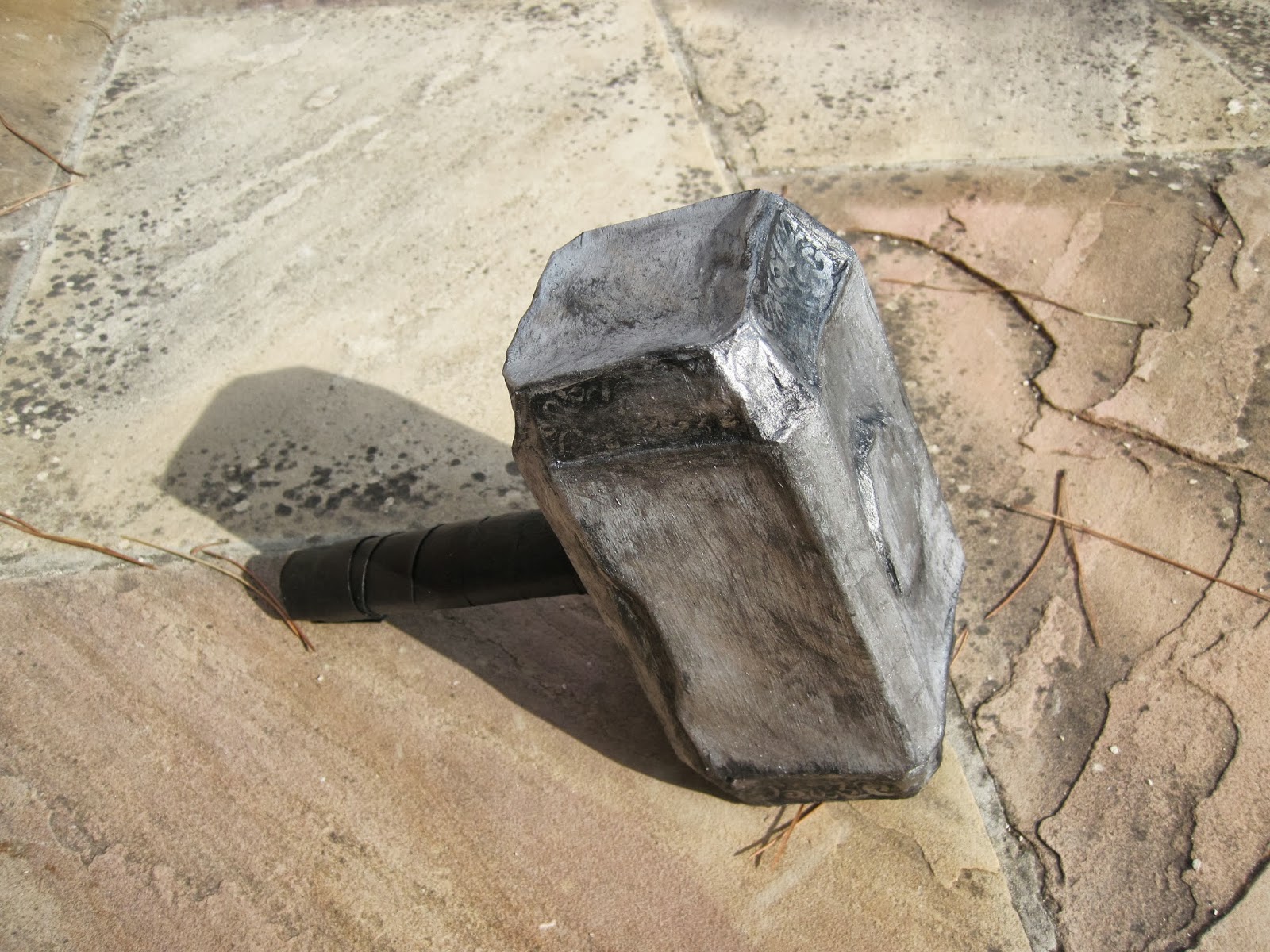
So this week's project had been (among others) to create a paper maché replica of the movie prop Mjolnir from Thor ad the Avengers. There was no reason behind making this other than I just really wanted something to do. And so I did.

I started out with old cereal boxes and a paper towel tube.

Once I had all these put together, I cut out the basic pieces to the shape I needed. I assembled them using sticky kraft paper, and covered the entire form with newspaper and tapestry glue. 


I then gave the entire surface two coats of thick white acrylic paint and let it dry completely before I coated it with the basic colors I wanted: grey and black. The handle was left bare because i found pleather I could use as a more "authentic" grip.


I then did more detailed painting with a toothbrush to create an aged look. I blued on the pleather strip with basic white glue and then aged that as well by rubbing black acrylics onto it. And voila!


Not perfect, but fun to make. And it leaves room for pranks!


Sarah


September 25, 2013

Projects Update (and other things)

So much has happened in the past few days...
First of all, I've gotten hired by an association at Sciences Po (Paris) to design their flyers and their website. They specifically asked for "the founders of Europe... but sexy".
Which led to me having to ask them just how sexy they wanted. I ended up putting Mitterand's head on a bikini model (too sexy) and a party whistle in Sweig's mouth (not sexy enough). Eventually, we reached a balance. Here's my personal favorite:
I designed one with Thatcher (seeing how much she wanted to distance herself from this whole "Europe" thing), but unfortunately, it was confused as either being 
  1. Sexist
  2. Merkel 
  3. Mrs Doubtfire
Which I found highly confusing, seeing as how this is Sciences po we're talking about here, and they should really know their politicians.

I also finally finished my embroidery projects! The last stitch went on Zoidberg this morning, and I was sewing the pillow all afternoon. They're made from recycled jeans.

And speaking of recycled jeans... found an old pair I had put in the "denim" pile two years ago because it was too tight. it now fits perfectly. Success!

Before I go to the states, I need to finish my sweater. I'll work double time on it (I'm halfway up the first sleeve!) but I've also got some drawing I need to do, and I'm going to be painting the Paper mache replica of Thor's hammer sometime later, hopefully this week.

Until then, anonymous strangers on the internet... 'till the next time.

Sarah

PS have some music


September 24, 2013

Dress Code

I have to say, I hate shopping.

Many girls my age love it. They love picking out outfits that are both flattering and a canvas for their own expression. They love grabbing something their size and finding out that it's "so them". This is how it is for my friends, at least. Why can't I have that experience?

Just for the record, I'm not fat. I'm not even overweight. I have the ideal BMI for my height. Perfect hourglass figure down to the millimeter. But I'm also short, and more importunely, curvy. People say it's the good kind of curvy (It's not another way of saying I'm "big", because I'm not. I wear size S for the most part.) and yet, when I shop, it seems that the clothes I see are more suited for magazines than for me.

In a nutshell, I need to buy trousers as part of the dress code for working at the National Air and Space Museum. I need black trousers - simple, right? Everywhere should have casual black trousers that fit without being too... revealing. It's a basic cut. The first thing you learn to sew. Easy. Right?

Wrong.

I'm very used to having to hem every single one of the pants that I buy, due to my short stature. It's normal. Not everyone is tall, some us us can be used as a perfect measurement of 5 feet. I don't expect to find "short" pants. That's normal.
But when the only pants I can find are slims, tight jersey that squeezes your thighs, or a pant cut so that my knee is actually halfway dwon my shin, its gets pretty darn ridiculous.
If I try a size 38, the waist is perfect, but the legs are so squeezed into the pants that you can see the inside pocket lining as it hugs my thigh. But if I take a size 40, the waist is large enough to fit two of me, and I could be mistaken for wearing harem pants. Not. Cool.

And it's like this everywhere I go. I stopped into Zara to try on their pants (almost every one of them was slim!) and overheard the women next door with the same problem.
"It's like they're dressing a virtual woman," one of them huffed. "Someone who only exists in their minds."
She then stepped out of the changing room to reveal a shirt long enough to be a dress that was so tight around her arms she described them as looking like "sausage casings".
This woman looked perfectly healthy to me. And she wasn't short, either.

The only place that gets it, from my experience, is Levi's. They have shapes. They have different lengths. They have a wonderful selection to top it all off. But the price! I know you have to pay for quality, But I dread having to pay double, triple even,  just because I'm don't look like women in magazines.  It's not even a question of quality anymore, it's a question of availability.

When I'm in the states, I have to shop in the petites section, just so that I can find pants that fit both my waist and my thighs. The problem here lies with selection. How many teenagers do you see shopping in the petite's section? Not many. The designs don't even impress my 60-some year old grandmother, also a petite (it's genetic, all the women on her side of the family have the same body type as I do. My mother, her mother, and her mother before her. Only my sister is exempt.), who, like me, wishes for variety.
I'm 18, not 80.  I have a body I'm proud of, I don't want to let it hide in saggy, baggy, oversized shirts with whimsical butterflies just because my bust is D cup.  I also don't want to impose my thighs on the world, squeezed into obviously tight slim pants. I want to dress comfortably. I want to be happy.

My wish for the world is that clothing came in all shapes and sizes, not just the "normal" girl (who makes up, what? 20% of the population of women?), that they didn't have to have my breast hanging out or my stomach on display just because I am young. I wish for flattering fits. For cute designs. For variety.
Some of us don't want fashion. But we still have to dress ourselves. We're not all model thin, model shaped, we're people. We're different. And because we're different, we need clothes that fit different people.

I know that profit wise, this is tough. You can't offer everything. But I'm not shopping at your store if I have to re-sew your clothes.

Now I'm going to stop wishing and start praying. Hopefully I can find appropriate clothing on thursday - if not, I'll be going to the fabric store rather than a clothing store the next time I need pants.

Yours truly,
Sarah

And here is some music. Enjoy.